Diagnostics
A FAIL score is not an actionable bug. memx maps each failed question onto a memory-pipeline stage using store snapshots (export_state before and after ingesting the full case history) plus what query returned.
Classification runs only on questions the judge marked FAIL. Passes are not diagnosed.
What you look at
After memx run, the CLI prints a Diagnostic Summary (counts and % of FAILs per stage) and writes .memx/last_run.json.
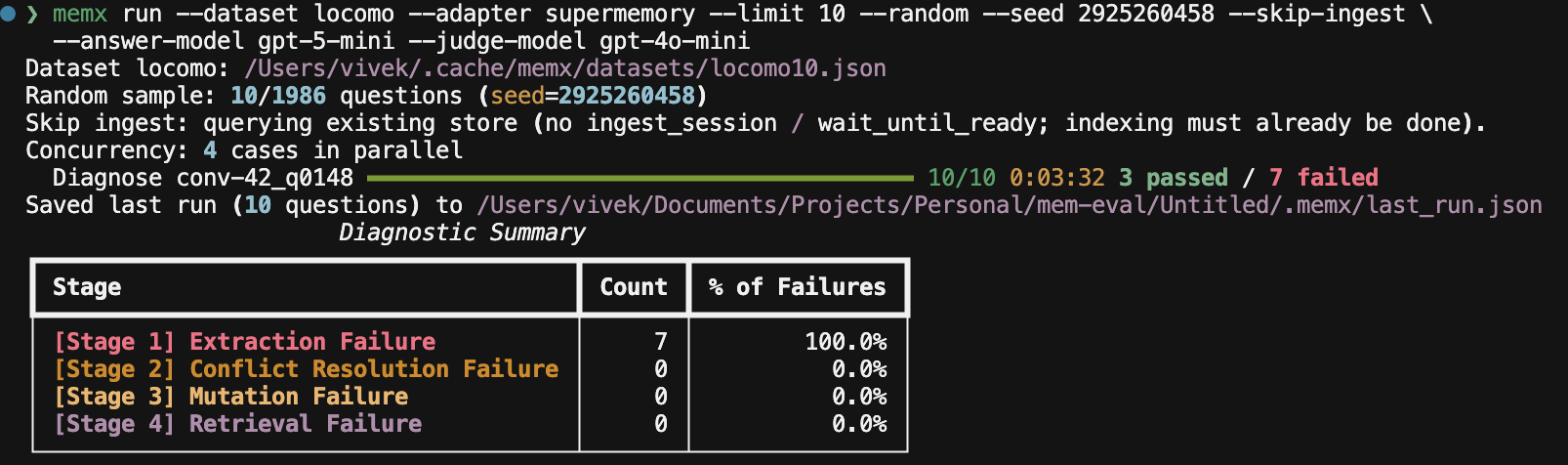
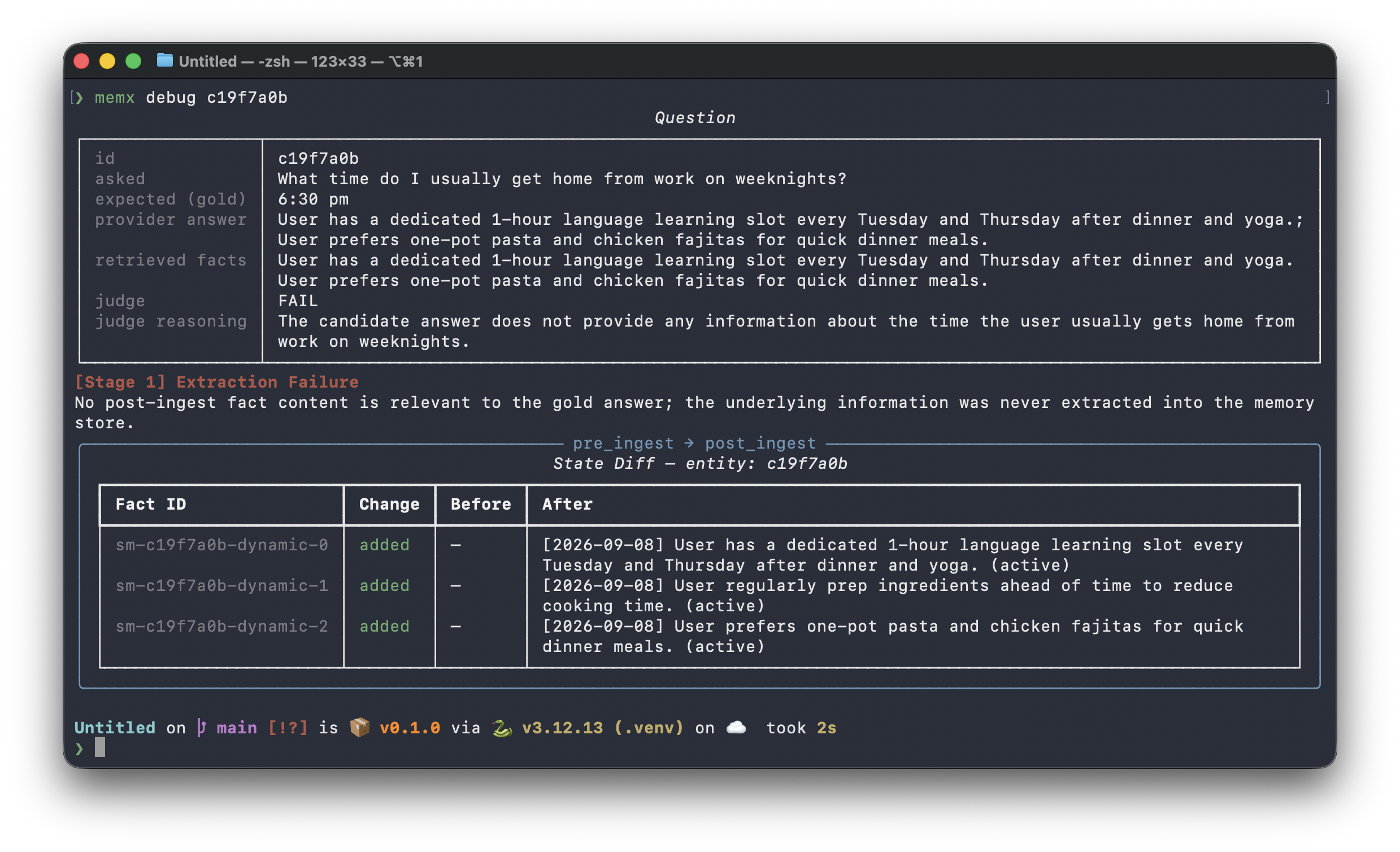
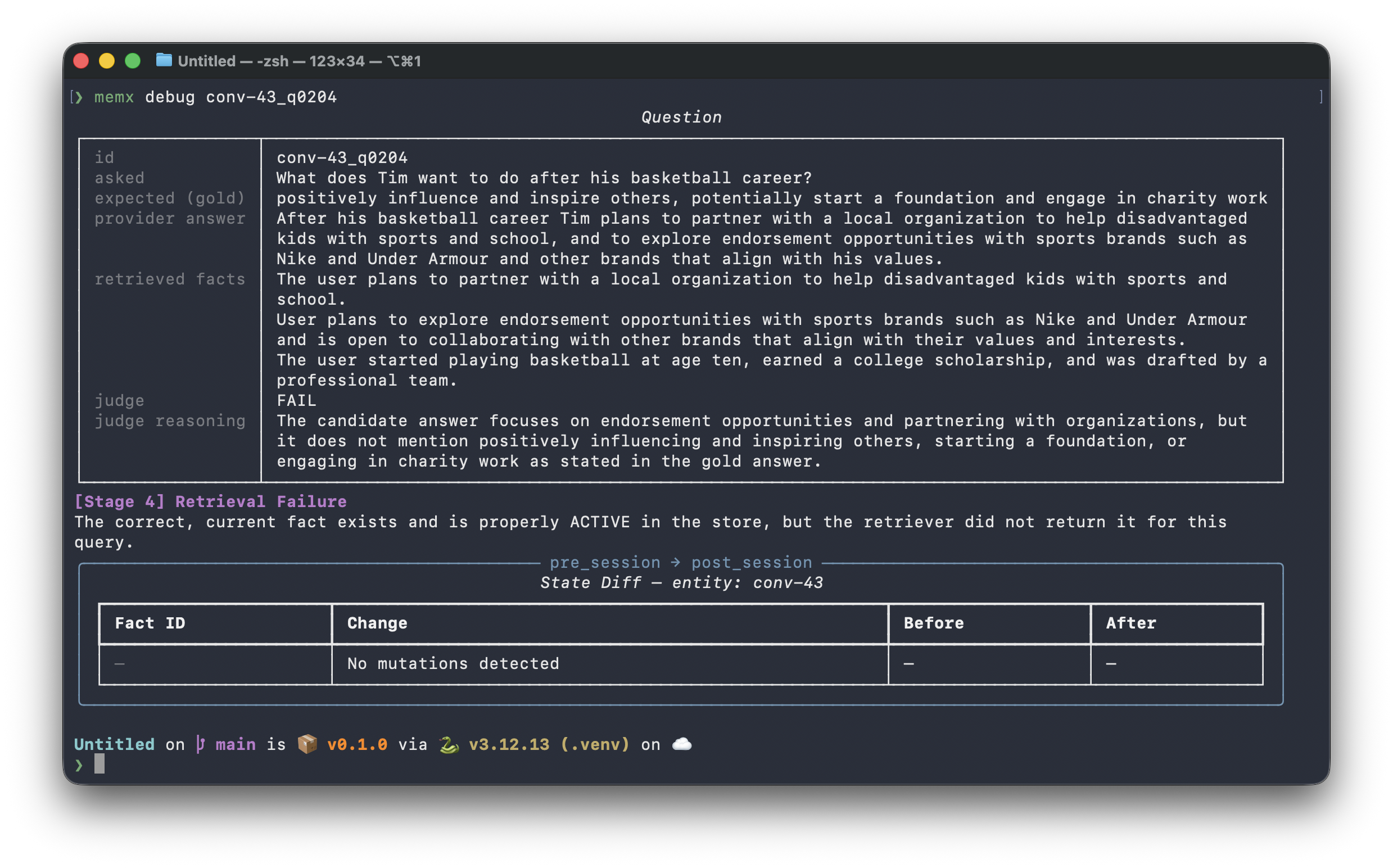
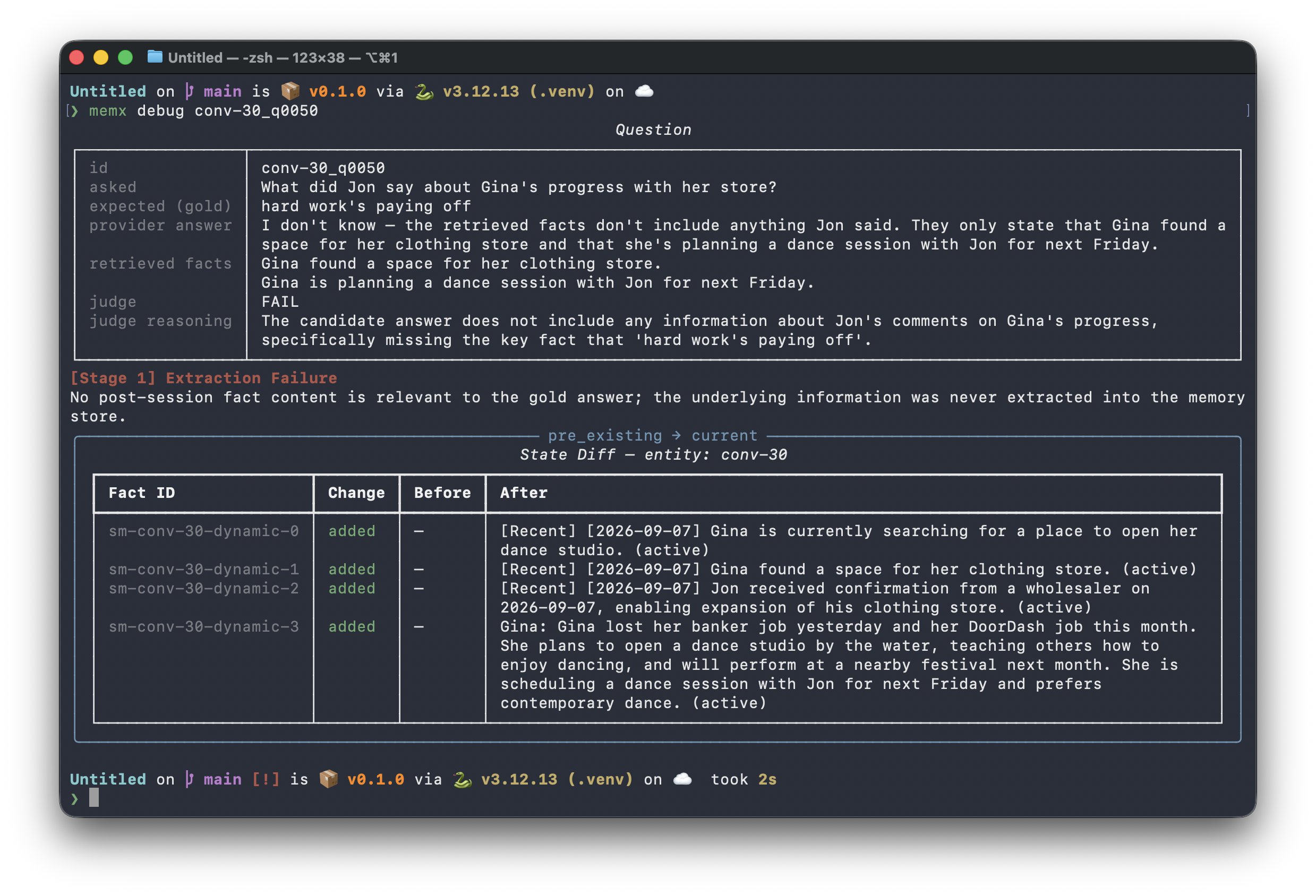
memx debug pretty-prints one record from the last run: question, gold, candidate, judge verdict, retrieved facts, taxonomy stage, and state diff. It does not call the adapter.
Hosted-adapter FAILs often show related text in retrieval while export_state does not contain a fact the judge treats as gold-relevant:
Same taxonomy on LongMemEval (oracle / evidence sessions):
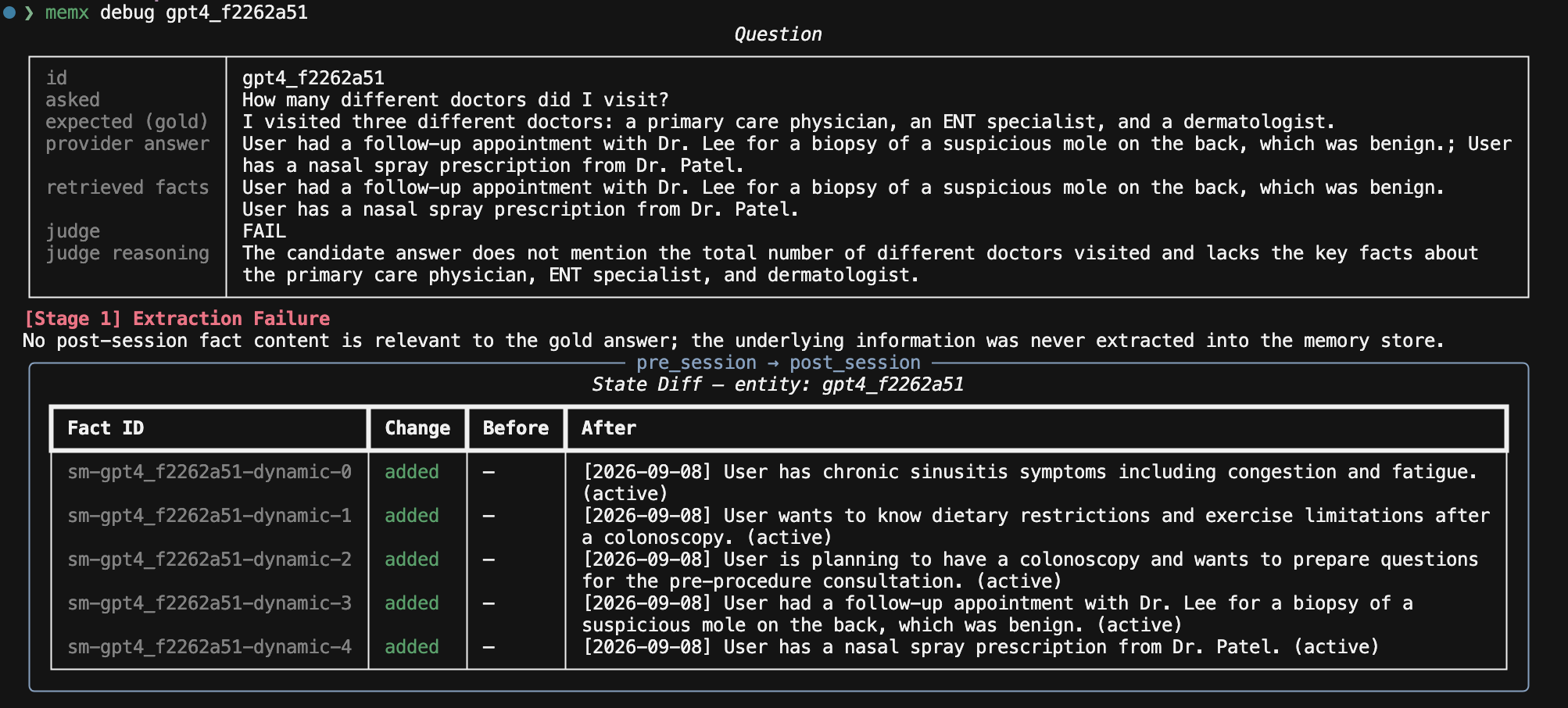
The JSON includes question text, gold, candidate, verdict, retrieved fact strings, diff, and diagnosis. A conversation that hits AdapterTimeoutError (or other AdapterError) is skipped; questions already finished in other conversations are still saved.
Stages
Evaluated in order. First match wins.
| Stage | Meaning | Structural signal |
|---|---|---|
| 1 Extraction | Needed fact never entered the store | No post-snapshot fact is relevant to gold (relevance_fn = judge, once per fact) |
| 2 Conflict | Two truths both ACTIVE | Multiple relevant ACTIVE facts with no supersedes link |
| 3 Mutation | Conflict linked, old row not retired | Relevant fact supersedes an id that is still ACTIVE |
| 4 Retrieval | Store looks correct, search missed | Relevant ACTIVE facts exist; none of those ids appear in query |
| (none) | Memory path looks fine | Judge failed but state + retrieval pass the checks (often synthesis) |
Pipeline per selected question
flowchart TD
  ingest["Ingest every session in order"]
  wait["wait_until_ready"]
  snap["export_state pre_ingest and post_ingest"]
  diffNode["Diff by fact id"]
  query["query the question"]
  answer["Build candidate answer"]
  judge["Judge against gold"]
  classify["Classify FAIL stage"]
  ingest --> wait --> snap --> diffNode --> query --> answer --> judge
  judge -->|"FAIL"| classify
Questions on the same case share one ingest, wait, and diff. --skip-ingest skips ingest/wait and diffs empty-pre vs current export_state. Query errors become empty retrieval. The prior run must have ingested the full case history.
Stage 1 cost scales with FAIL count × facts in the snapshot. Some adapters return large exports; a cheap --judge-model (for example gpt-4o-mini) matters more than the answer model on FAILs.
Stage 1 is also sensitive to export vs search: search can return related chunks while export_state does not contain a fact the judge treats as gold-relevant.
Worked example: same benchmark item, different adapters
LongMemEval oracle question c19f7a0b: What time do I usually get home from work on weeknights? Gold: 6:30 pm.
The dataset contains that time. The evidence turn (has_answer: true) is the user saying they usually get home around 6:30 pm, then make dinner and do yoga before language learning on Tuesdays and Thursdays.
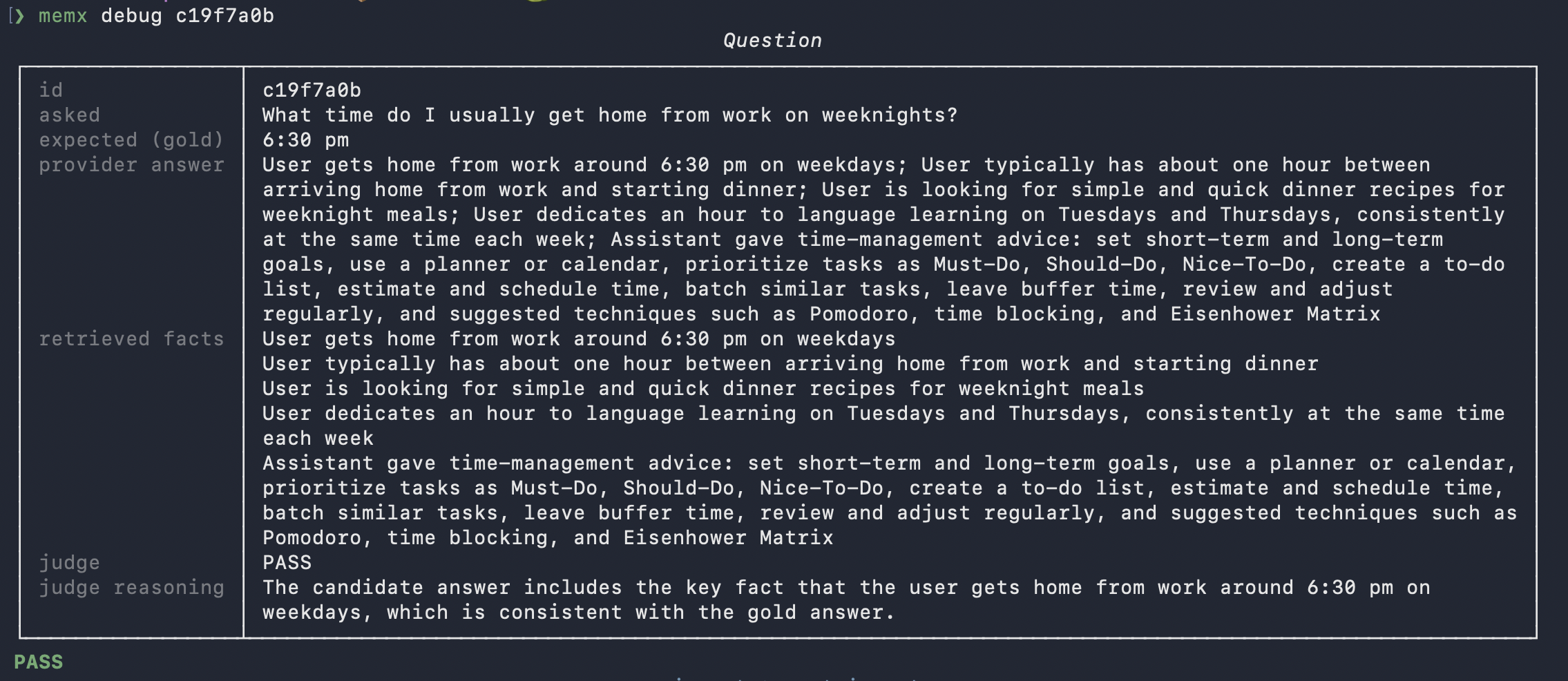
Run the same --dataset item with two --adapter values. memx does not change the haystack. One backend can FAIL (and get a stage) while another PASSes. memx debug shows the miss or the hit.
| memx surface | --adapter supermemory |
--adapter mem0 |
|---|---|---|
| Retrieved facts | Dinner / yoga / language-learning. No 6:30. | User gets home from work around 6:30 pm on weekdays, plus dinner and language-learning memories |
export_state (post-ingest) |
A few lifestyle bullets. No 6:30. | Separate memories, including a fact whose text is the 6:30 sentence (stable UUID fact_id) |
| Judge | FAIL | PASS |
| Diagnosis | Stage 1 extraction | None — passes are not classified |
That is the point of the harness: adapters do not fail the same way on the same item. One store kept neighboring details and dropped the clock time (Stage 1, not a Stage 4 miss, and not a truncated haystack). The other extracted the time as its own row, so retrieval and the candidate included it and the judge PASSed.
memx run --dataset longmemeval --adapter mem0 --limit 5 --random \
  --judge-model gpt-4o-mini --ready-timeout 600
Swap --adapter for another supported name (Adapters). --dataset longmemeval is the oracle split. Use the same --seed to hold the question set fixed.